

Errorless Learning – A good thing?
16th November 2025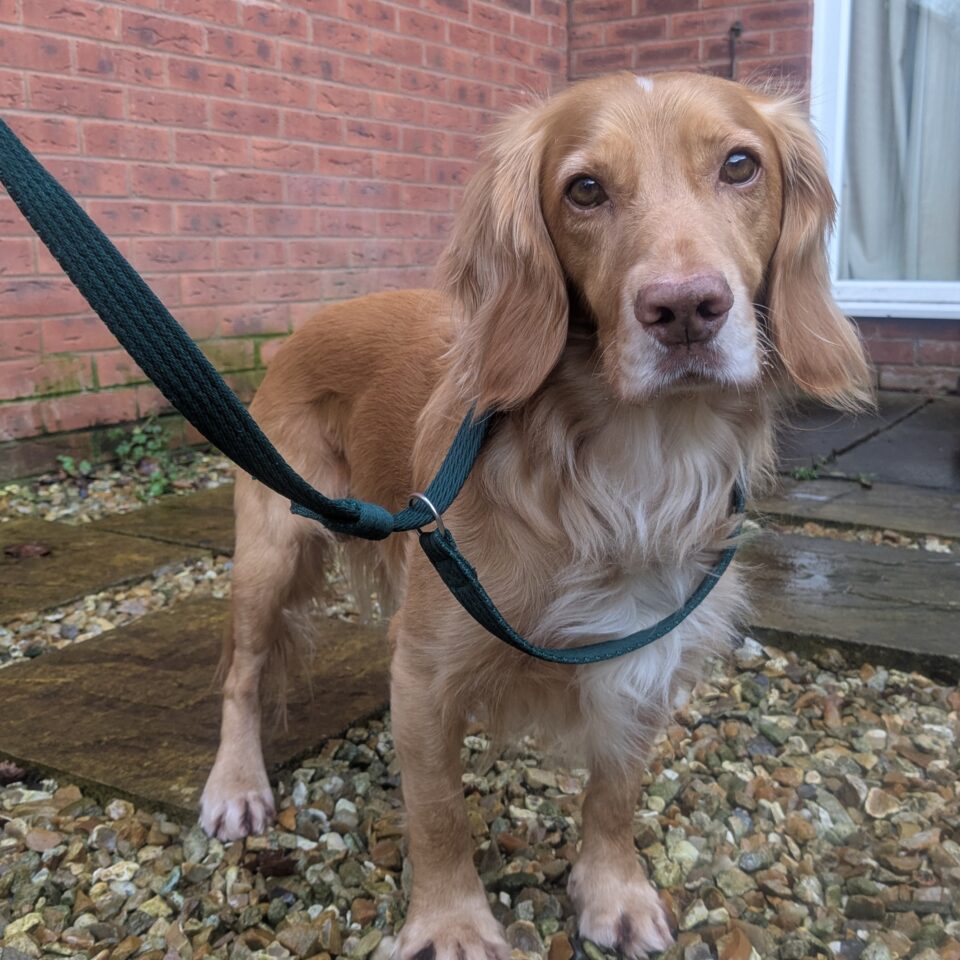
Slip Leads – Friend or Foe?
I saw a post recently where the owner of a puppy wanted to know whether to use a slip lead or harness when training their pup to walk nicely on a lead.
Predictably there were two camps, pro slip lead and pro harness.
So, I thought I would put my thoughts on the subject down in a blog.
Slip leads
Slip leads as a piece of equipment can be useful or harmful depending on how they are used.
I am happy to use a slip lead on a dog who knows how to walk well on a lead and can manage themselves in challenging situations so there will be no lunging or pulling going on.
They are a great safety measure when out shooting and your dog is not wearing a collar. Easy to put on and off. I personally choose to use a limited slip lead as this has all the benefits of a slip lead – no collar required, but all the benefits of a fixed collar – no garrotting if the dog pulls. I also prefer to use a limited slip that is about 25mm wide, which is the same as a normal collar.
The reason that I prefer to use a wider slip lead is because no dog is perfect on the lead all of the time. At some point they may get to the end of the lead and so I want to spread the force as much as possible to reduce any potential damage to the neck and throat.
I will not use a slip lead on a dog who is in training. Dogs who are in training, by description need to learn how to walk on a lead. There will be lots of mistakes, lunging and pulling when the dog is overwhelmed or triggered by the environment.
If a dog pulls or lunges, even if the human is not using a physical jerk on the lead to ‘correct’ or punish the pulling, the lead will be constricting the dog’s neck. This means that there is reduced blood flow, and therefore oxygen flow, to the brain, thus restricting the brain’s ability to function well, at the very point that it needs to be able to process at its best. To me this seems very counterproductive.
The added physical damage that can be done is very real. Dogs have no more protection over their throat area than we do. There are many very important structures in this area.
- Trachea – the dog needs to be able to breathe
- Larynx – the dog’s vocal cords are very easily damaged and can collapse through damage later in life, causing life threatening blockages to the wind pipe.
- Arteries and veins – the dog needs blood to flow to and from the brain
- Spinal cord – the dog needs to be able to communicate with their limbs
- Vertebrae – the dog need these to remain in alignment for their spinal cord to function
- Thyroid gland – easily damaged and this can then mess up the dog’s endocrine feedback system
- Muscles and skin – dogs bruise just as easily as we do. Narrow rope leads either constantly putting force through the same area or repeatedly being applied to the same area will cause bruising and trauma to the underlying skin and muscles.
Also, some people advocate using a slip lead high up behind the dog’s ears. This can also put a massive amount of pressure through the spine at a critical junction between the skull and the spine. It is effectively acting as a hangman’s noose. The hangman used to put the rope at this point to help the neck to break to make the hanging a quick way to kill someone!
Celia Cohen, a highly qualified physiotherapist, did a great explanation of the potential damage that a slip lead can create when used like this, in a post that can be found by following this link. https://www.facebook.com/photo?fbid=10158654774241006&set=a.435127806005
There are many reasons that using a slip lead whilst a dog is in training, will physically be uncomfortable or painful, and can potentially cause long term physical damage to a dog/pup.
Another reason that I won’t use a slip lead in training is I personally don’t think it is fair to cause pain and discomfort to a dog who doesn’t have all the tools to carry out a behaviour that is totally alien to them.
Is it OK to punish a learner for not knowing the answer to a question that they have not been give all the information to be able to answer?
Harnesses
Yes, a dog who is wearing a harness can pull harder than a dog wearing a slip lead.
Does this mean that harnesses teach a dog to pull? Absolutely not.
Dogs will pull against anything that restricts their access to things that they want until they are trained that, when they are on the lead, pulling is an unproductive behaviour.
I use harnesses during training because it protects two things
- The dog’s body
- My ability to train a dog to walk on a flat collar and lead
When we attach a lead to a harness and the dog lunges, the force is taken through their ribcage which is more robust in structure that the neck area. So, the likelihood of a dog physically damaging itself in a harness is much reduced.
The process of teaching a dog to walk on a lead is a long one. Life generally continues and we will have to take our dogs into situations that we have not been able to train for yet.
We need a way to manage our dog during the learning phase, whilst protecting the dog, the handler, and the training. Front clip harnesses and headcollars can provide the ‘quick fix’ management to help us protect our training and the dog whilst we are in the process of educating the dog to walk nicely on a flat collar and lead. I have written a blog on headcollars previously looking at the pros and cons, which you can find here – https://www.dogsrdogs.co.uk/making-an-informed-choice-about-using-a-headcollar-with-your-dog/
As with everything, not all harness are actually good for your dog to wear. Some styles can impair your dog’s gait, or actually compress their shoulder blades, which, especially in a young dog, can adversely impact their skeletal growth.
There has been some great research done on how different harnesses affect gait, that can be found here –
This is the style of harness that affects the dog’s gait the least – it can be called an h-style or y-style of harness.
This shape of harness can have a front d-ring to help with control.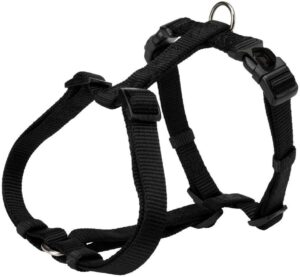
The types of harness that are not good for dogs, because they affect their gait patterns, are the ones that have a strap running horizontally across the front of their chests.
Examples can look like this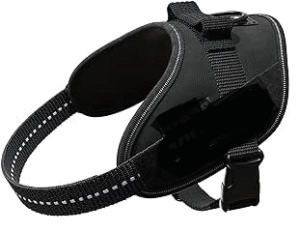
Or this – these compress the dog’s shoulder blades, and can pull into the triceps muscle attachments behind the front legs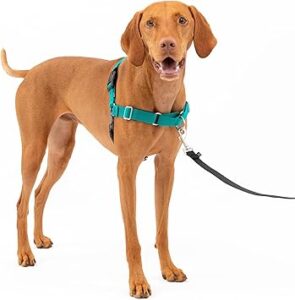
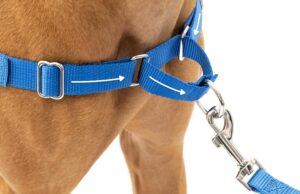
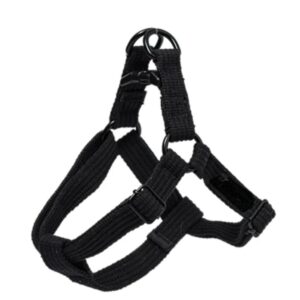
These also inhibit gait because of the strap across the chest, and can also pull into the rear of the front legs.
Finally, the style of harness that tightens behind the front legs can also cause damage to the triceps muscle attachments.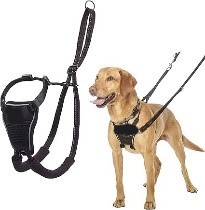
I have added these pictures so that you can pick the right harness for your dog. Not all harnesses protect the dog’s body from harm.
The reason that I use an h-style harness with a front d-ring attachment is so that I can have more control over my dog.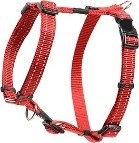
The rear attachment d-ring provides brakes, and the front d-ring attachment provides steering. This makes it easy to turn a dog away from anything that they want to pull towards.
Last thoughts
I think though, the actual question that the original poster was possibly asking is – what piece of equipment is going to make training my dog to walk on a lead the easiest and quickest process?
There is no quick way to teach lead walking. Some pieces of equipment can help to manage the situation whilst the dog is learning. It is up to you whether you choose one that can cause damage and pain or one that can be used with no pain and helps your dog to learn with less stress.
I manage dogs who are out of their learning comfort zone on a front-clip harness with a double ended lead or a headcollar.
I then teach the dog to walk nicely on a flat collar and clip lead. This means that all the mistakes happen on the harness or headcollar and all of the good learning happens on a flat collar and lead, in circumstances where the dog is cognitive and capable of learning and managing themselves. The learning challenges increase slowly as the dog’s learning progresses until finally, they can walk nicely without pulling everywhere.